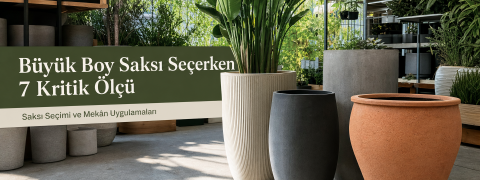
7 Key Factors to Consider When Choosing a Large Planter
Choosing a large planter is not just about selecting a container for the plant. Especially in projects involving hotels, restaurants, offices, villas, terraces, balconies, retail spaces, and large interior spaces, the size of the planter is a direct determinant of aesthetic appeal, plant health, ease of use, space management, and long-term performance. At Kasta Concept, based on our experience with pots, decorative products, artificial plants, and production, the most important lesson we’ve learned is this: Large planters that aren’t selected in the correct size can cause both visual and functional problems, rather than creating the expected sense of luxury and balance in a space. For this reason, when shopping for large planters, one must carefully evaluate not only the model, color, or material but also the relationship between the specific dimensions.
When considering planter selection and spatial applications, large planters are not merely passive elements of decoration but powerful design elements that define the character of a space. A tall, cylindrical planter used in an entryway can create a vertical effect extending toward the ceiling, making the space appear more prestigious. Wide-mouthed square planters, on the other hand, offer a modern, balanced, and strong presence. However, if the same product is chosen in the wrong size, it can narrow the passageway, make the plant appear smaller than it is, or look overly bulky, thereby disrupting the overall decorative harmony. For this reason, when selecting large planters, the issue of size cannot be considered separately from aesthetics.
Measurement of height
When choosing a large flower pot, one of the first measurements to consider is height. The pot’s height should be in harmony with the plant’s height, the floor levels where it will be placed, and the overall proportions of the space. A pot that is too short can diminish the impact of a tall plant; conversely, a pot that is too tall can make a small or medium-sized plant appear out of proportion, creating an unnatural look. Especially in focal areas such as living room corners, lobby spaces, the beginnings of hallways, and areas next to doors, the height of the planter directly affects the decorative impression.
One of the common mistakes made in interior design is choosing plants based solely on their current height. However, the plant’s growth potential, the total height of the composition if artificial plants are used, and the effect at eye level in the space must also be taken into account. For example, in areas with high ceilings, short planters often appear to be buried in the floor and do not produce a strong decorative effect. Conversely, in areas with low ceilings, excessively tall planters can create a sense of oppression. When selecting the height of large planters featured in the Kasta Concept collection, spatial proportions should be considered just as much as the plant’s height.
Mouth diameter measurement
The top diameter of the pot plays a critical role in the plant’s root development and visual balance. In large pots, the wider the rim diameter, the more space is provided for the plant’s soil volume and root spread. However, the key issue here is not simply the “bigger is better” logic. Pots with excessively wide rim diameters can affect the moisture balance around the roots differently in certain plant species and may also visually overwhelm the plant’s size. In particular, for plants with slender stems but tall stature, an excessively wide rim can disrupt the design’s overall harmony.
The mouth diameter is also important for artificial plants and decorative arrangements. In arrangements featuring large-leaved artificial plants, branched compositions, or multiple plants, determining the correct mouth diameter ensures that the product looks balanced and full. When a voluminous artificial plant is placed in a narrow-mouthed pot, the upper section appears heavy, and the pot may create an unstable appearance on the floor. For large planters to be displayed in spacious entryways, along terrace edges, and in commercial spaces, the selection of the mouth diameter must be professionally planned with both safety and design in mind.
Base width
One of the dimensions that many users overlook when choosing a large planter is the base width. Yet the area of the planter that rests on the ground is among the most important factors determining the product’s stability. Especially with large, tall, and narrow planters, an insufficient base width can increase the risk of tipping over. This is a serious issue not only for live plants but also for tall artificial plant displays. This measurement becomes even more critical on windy balconies and terraces, as well as in high-traffic areas such as stores and hotels.
Base width is also an important parameter for interior applications. Large planters used in narrow passageways, in front of elevators, or at the tops of staircases should not take up too much floor space, but at the same time, they should not compromise stability. For brands with experience in the production of decorative products and planters—such as Kasta Concept—the ideal solution is to offer size combinations that seamlessly blend visual elegance with floor stability. For this reason, one should consider not only the planter’s stylish form as seen from above but also how sturdy its base is.
Inner Depths
Just because a pot looks large from the outside doesn’t always mean it has sufficient internal volume. When selecting a large pot, internal depth is one of the most critical factors—especially if you plan to use live plants. For roots to develop healthily, for the soil to settle properly, and for the watering routine to be effective, the internal depth must be appropriate for the plant species. Pots that look large and impressive on the outside but have limited internal volume can restrict the plant’s growth over time.